
If your diesel truck suddenly gets stubborn when the temperature drops, you are not imagining it. Cold weather exposes weak points quickly, and diesel cold start problems show up at the worst time. A battery that felt acceptable in the fall may now crank too slowly. Glow plugs that were already fading may no longer create enough heat. Fuel that flowed fine a few weeks ago can start causing trouble once winter hits hard.
That is why diesel cold start problems can feel inconsistent at first. One morning, the truck starts rough. The next morning, it needs a few extra seconds. Then one cold snap later, it will not start at all.
The good news is that most winter no-start issues follow a pattern. If you know what the symptoms usually point to, you can make better decisions and avoid throwing parts at the wrong problem. In this guide, we will break down the three big trouble spots, what the warning signs mean, what to check first, and when it is time to stop guessing and get the truck tested properly.
Why diesel trucks struggle more in cold weather
Diesel engines do not rely on spark plugs the way gas engines do. They depend on heat created through compression. That works well when everything is healthy, but cold weather makes that process harder.
When temperatures drop, engine oil thickens, batteries lose effective power, and diesel fuel becomes less cooperative. At the same time, the engine needs a strong cranking speed and enough combustion heat to get running cleanly. If one part of that equation is weak, a cold start gets rough in a hurry.
This is why winter tends to expose problems that were already there. The battery may not be fully dead. The glow plugs may not be fully failed. The fuel may not be fully gelled. But cold weather reduces your margin for error.
For work trucks, farm trucks, and towing rigs, that matters. A truck that starts poorly on a mild day can become a no-start problem during a real Alberta cold snap. That is also why winter diesel issues should be treated as reliability problems, not just annoyances.
The three most common cold-start trouble spots
Glow plugs and why they matter
Glow plugs help warm the combustion chamber, allowing the engine to ignite fuel more effectively during startup. On a cold diesel, they do a lot of heavy lifting in the first few moments. If one or more glow plugs are weak or not functioning, the engine may crank longer, start rough, smoke, or refuse to start in colder temperatures.
Glow plug problems often show up as a truck that starts worse as it gets colder. You may also notice a rough idle right after startup or white smoke from incomplete combustion. In some cases, one failed glow plug will not cause a total no-start on its own. But multiple weak glow plugs, a relay issue, or a control problem absolutely can.
The mistake many owners make is assuming that because the truck eventually starts, the glow plug system must be fine. Not true. Hard starts are often the early warning.
Battery strength and cranking speed
A diesel needs a strong cranking speed. That means battery condition matters even more than many people think. In cold weather, battery output drops, while the engine becomes harder to turn over. That is a bad combination.
A weak battery can cause slow cranking, repeated failed starts, or an engine that turns over but never builds enough speed for a clean start. Some drivers hear the engine crank and assume the battery is fine because it is not completely dead. That is not how this works. A diesel can have enough battery power to crank, but not enough to crank well.
Corroded terminals, tired batteries, poor cable condition, charging issues, or voltage drop can all cause cold-start trouble. If the truck cranks slowly in the morning but improves later in the day, the battery and starting system move to the top of the suspect list.
Fuel quality, fuel filters, and gelling
Cold weather affects diesel fuel, too. In lower temperatures, wax crystals can form in untreated or poorly protected fuel. That can restrict flow through the filter and fuel system. Once that happens, the truck may crank without starting, lose power, or start and then stumble.
Fuel problems are not always dramatic. Sometimes it is not a full gel event. Sometimes it is a restricted filter, marginal winter fuel protection, water contamination, or an overdue fuel filter that becomes a bigger problem when temperatures drop.
This is one reason winter diesel prep matters so much. If fuel flow is compromised, the engine may act like it has an electrical problem when the real issue is fuel delivery.
What the symptoms usually point to
Slow crank
If the engine sounds lazy, heavy, or slower than normal while cranking, start with the battery and electrical side. Low cold-cranking power, weak cables, poor connections, or starter-draw issues are common suspects.
Glow plugs do not usually cause a slow crank. They affect combustion heat, not cranking speed. So if the engine is clearly turning over too slowly, think battery, cables, charging condition, or starter load before you think fuel.
Cranks but will not start
If the engine cranks at normal speed but does not fire, the problem is often due to glow plugs, fuel delivery, or system control issues. This is where the pattern matters.
If the truck is worse after sitting overnight in the cold and gives you a long crank with no real attempt to catch, glow plugs or fuel issues rise to the top of the list. If it starts eventually after several tries, that still does not mean things are fine. It usually means a weak system is barely getting by.
White smoke and rough startup
White smoke during a cold start often points to incomplete combustion. That can happen when the fuel is present, but chamber heat is lacking. Weak glow plugs are a common reason. So, is poor combustion caused by low cranking speed?
If the truck starts rough, smokes white for a short time, and then smooths out, pay close attention. That pattern often says the engine is struggling to create clean combustion during those first moments.
What to check first before you replace parts
Start simple.
First, pay attention to cranking speed. Is it strong and even, or slow and dragging? That one observation helps narrow the problem fast.
Second, think about the temperature pattern. Does the issue only occur on colder mornings? Does it improve later in the day or after being plugged in? That can point toward glow plug performance, battery weakness, or both.
Third, consider fuel condition. Was the truck fueled recently with winter-ready diesel? Has the fuel filter been changed on schedule? Have there been any signs of restricted fuel flow, hesitation, or a recent sharp temperature drop?
Fourth, avoid guessing based on a single symptom. A weak battery and weak glow plugs can stack on top of each other. An overdue fuel filter can make an already marginal starting system look worse.
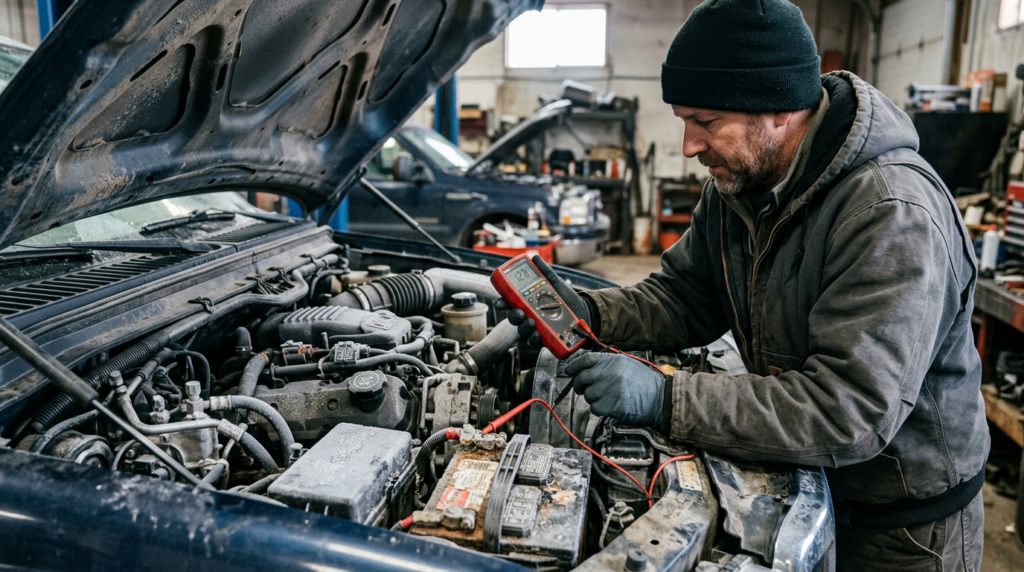
If you have repeated hard starts, this is where proper testing becomes more valuable than swapping random parts. Battery load testing, voltage checks, and glow plug circuit testing will usually save time and money compared to trial-and-error.
How to prevent diesel cold-start problems
The best fix is often prevention before the first brutal cold snap hits: regular diesel repair and maintenance.
Keep the batteries tested before winter, not after the truck strands you. Replace aging batteries before they become a morning problem. Make sure cable ends are clean, and connections are tight.
Stay ahead of fuel filter maintenance. A filter that is merely dirty in warmer weather can become a bigger restriction in winter. Use the right seasonal fuel practices and, where appropriate, quality anti-gel protection.
Use the block heater when conditions call for it. A block heater can reduce engine stress and improve starting, but it is not a magic fix for a failing battery or bad glow plug system. Think of it as support, not a cure.
Oil choice matters too. If the engine oil is too heavy for winter use, cold starts become harder on the battery and the entire starting system.
For trucks that earn their keep every day, winter prep is not overkill. It is cheaper than downtime.
When a hard start becomes a shop problem
If the truck has repeated cold-start issues, do not wait for a total no-start before getting it looked at.
A shop should get involved when:
- The engine cranks slowly, even after charging the batteries
- The truck repeatedly needs multiple attempts to start
- White smoke and rough idle keep showing up on cold starts
- The truck starts better when plugged in, but still struggles too much
- You suspect fuel gelling, filter restriction, or a glow plug control problem
- You are already guessing between multiple possible causes
This is where proper diesel diagnostics matter. A good inspection can separate a battery issue from a glow plug issue, a fuel delivery issue, or a starting system issue before money gets wasted on the wrong repair.
If the truck is a daily-use work truck, farm truck, or tow rig, the real cost is not just the repair bill. It is lost time, lost reliability, and the risk of getting stuck when you need the truck most.
Diesel Cold Start Problems FAQ
What causes a diesel engine to be hard to start in cold weather?
Usually, it comes down to insufficient heat, insufficient cranking speed, poor fuel flow, or some combination of the three. Glow plug problems reduce combustion heat. Weak batteries reduce cranking speed. Fuel gelling or restricted fuel filters reduce fuel delivery. Cold weather makes every small weakness more obvious, which is why a truck that seemed fine in the fall can suddenly struggle in winter.
Can a weak battery cause a diesel to crank but not start?
Yes. A diesel can crank without cranking well. That is the part many people miss. If battery output is low, the engine may turn over but not fast enough to build proper combustion conditions. In cold weather, that reduced cranking speed can be the difference between a clean start and a long, frustrating no-start.
How do I know if my glow plugs are bad?
Common signs include longer crank time in cold weather, rough startup, white smoke, or a truck that only starts well when temperatures are milder. If the engine spins normally but struggles more as the temperature drops, the glow plug system becomes a strong suspect. The right move is to test the system rather than assume which plug or component is bad.
What does diesel fuel gelling feel like?
It often shows up as hard starting, cranking without firing, poor fuel delivery, stumbling, or loss of power after startup. In some cases, the truck may start and then run poorly because fuel flow is restricted. It is not always an all-or-nothing failure. Partial restriction through the filter is common enough to cause trouble.
Will a block heater fix a cold-start problem?
A block heater can help a lot, but it does not fix an underlying defect. It reduces strain by warming the engine, which improves starting conditions. That said, if the batteries are weak, glow plugs are failing, or the fuel system has a restriction, a block heater may only mask the issue for a while.
Can one bad glow plug cause hard starts?
Yes, especially in colder weather, though the severity depends on the engine and the rest of the system. One failed glow plug may cause a rougher start rather than a total no-start. Multiple weak glow plugs, a relay issue, or a control fault create bigger problems. The important point is that partial failure still matters in winter.
Why does my diesel make white smoke when starting cold?
White smoke during startup often means the fuel is not burning cleanly right away. That usually points to low combustion heat, weak glow plug performance, or low cranking speed. The smoke may clear once the engine catches and warms slightly, but it is still a warning sign that the cold-start process is not healthy.
When should I stop troubleshooting and call a shop?
Call a shop when the issue is recurring, the symptoms are worsening, or you are no longer dealing with a one-off event. If the truck is hard to start on multiple cold mornings, cranks slowly, smokes heavily, or leaves you unsure whether the problem is battery, glow plugs, or fuel, proper testing is the smart move.
Diesel Cold Start Problems Conclusion and Next Steps
Most diesel cold-start problems stem from the same core areas: combustion heat, cranking strength, and fuel flow. The trick is not memorizing parts. It is paying attention to the pattern. Slow crank usually points you in one direction. White smoke and rough startup point another. Fuel restriction brings its own clues.
If your diesel has been harder to start in cold weather, treat that as an early warning, not a minor inconvenience. A truck that only barely starts today has a way of not starting at all on the next brutal morning. If you want clear answers without guesswork, Fast Farm Garage diesel truck service in Okotoks can help diagnose the actual cause of the problem and what needs attention before reliability worsens.